NASA's SDO Observes Largest Sunspot of the Solar Cycle
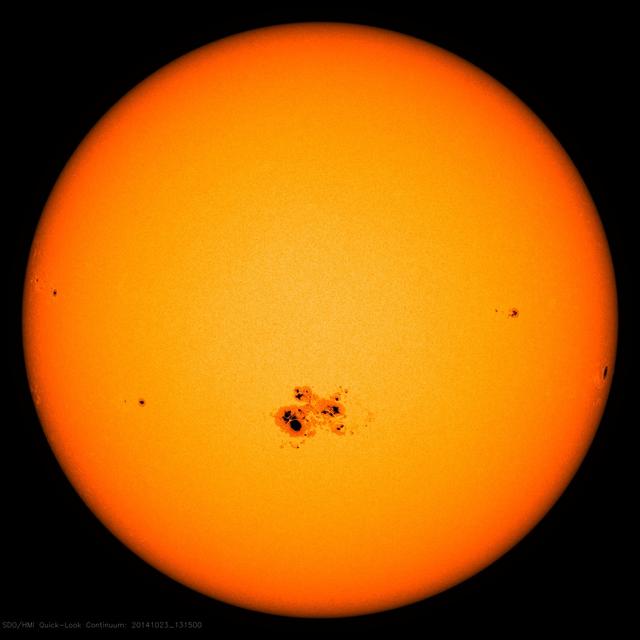
On Oct. 18, 2014, a sunspot rotated over the left side of the sun, and soon grew to be the largest active region seen in the current solar cycle, which began in 2008. Currently, the sunspot is almost 80,000 miles across -- ten Earth's could be laid across its diameter. Sunspots point to relatively cooler areas on the sun with intense and complex magnetic fields poking out through the sun's surface. Such areas can be the source of solar eruptions such as flares or coronal mass ejections. So far, this active region, labeled AR 12192 -- has produced several significant solar flares: an X class flare on Oct. 19, an M class flare on Oct. 21, and an X class flare on Oct. 22, 2014.
- Category
- The Sun
- Date
- 2017-12-08
- NASA center
- GSFC
- Catalog ID
- GSFC_20171208_Archive_e000923